
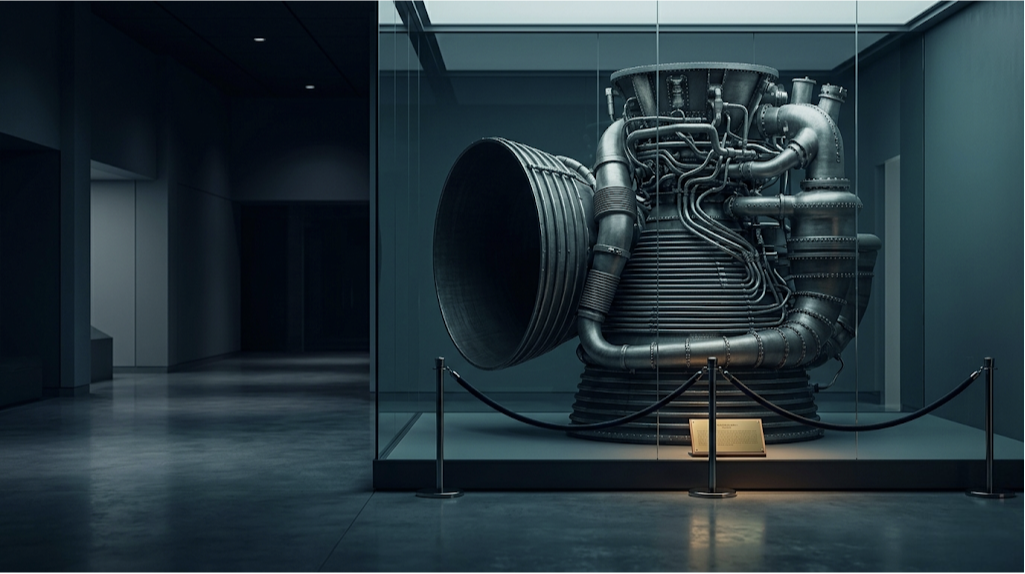
In the 1960s NASA built the F-1, the engine that lifted the Saturn V off the pad. It is still the most powerful single-chamber rocket engine ever flown. Decades later, when engineers wanted to build it again, they could not. The blueprints had survived. The knowledge had not. Each engine was finished by hand, full of small undocumented adjustments that lived in the people who made them, and those people had retired or died. In 2013 NASA pulled an F-1 out of a museum and reverse-engineered its own engine, because recovering it from the metal was easier than recovering it from the organisation.
Your company is not NASA. It has the same problem.
Someone hands in their notice and does everything right. Three weeks of handover, the drive reorganised, a final week of meetings where they answer every question anyone thinks to ask. Then they leave. A month later the team hits a problem they have seen before, and nobody remembers it was solved two years ago, or how, or why the obvious fix is the one to avoid. The answer was never in the handover doc. It was in the person, and it walked out with them.
This has a name. Corporate amnesia: the knowledge a company loses when its people leave. Every company runs on memory it cannot see. The reason you do not deploy on a Friday. The client who churns the moment the wrong person is cc’d. The integration that looks broken but is meant to behave that way. None of it is written down, because none of it is the kind of thing anyone thinks to record. People carry it. And every attempt to fix that has treated it as a storage problem.
The knowledge management system was never the problem
The standard answer to corporate amnesia is to write more down. Roll out SharePoint. Stand up a knowledge management system. Buy the enterprise search tool that promises to find any answer in the company. You have lived through at least one of these. You know how it ends. The pages go stale. The search returns the document nobody trusts. The thing that mattered was never in there to begin with.
That was not a tooling failure. It was a category error. The knowledge that keeps a company stable is mostly judgement, and judgement does not survive being written down. It lives in the person who knows which exception is safe and which one is the start of an incident. The people inside a system act as compensating middleware, holding it together with informal work that never appears in any document. Organisational memory is that work, spread across a whole company. The knowledge base captured the documents. The people carried the rest. It left when they did.
Why AI memory changes this
A persistent AI memory can reach the layer the knowledge base could not, because it sits in the flow of the work instead of waiting for someone to stop and record it. It captures what was chosen, when it was true and what later replaced it. A document ages quietly and says nothing. A memory built this way knows when it has gone out of date.
Point an AI assistant at the same stale pages and you get a smarter search box. That is the easy version to build, and the small one. Memory in a production AI system is a stack of distinct layers, not a single backend. Aimed at the company rather than one user, it becomes what the knowledge base never could be. A record of how the organisation thinks, kept current as the work happens. The time-aware facts I have described for a coding agent are what a company needs to answer “what is our policy now?” without dragging up three superseded versions of it first.
The payoff is specific. A company that stops re-solving the same problem every two years. A new hire who inherits the reasoning, not just the file. Knowledge that compounds instead of resetting each time someone resigns. For the first time that is something you can build into the architecture rather than hope for in the culture.
A memory you do not govern is a liability
The same property that makes this valuable makes its failures expensive.
A persistent memory acts on what it holds. The moment a wrong fact enters it, the company starts reasoning from the error, and a confident wrong answer does not stay a private mistake. It becomes the thing new hires are taught in their first week. AI memory reconstructs rather than replays, so the errors are not rare edge cases. They are how the system works. And a memory of the whole company raises the same question a persistent model of one person does, only larger. Whose memory is this. Who is allowed to write to it. When the record and a senior person disagree about what was decided and why, which one wins.
These are not questions to answer once the system is running. They are the design.
What organisational memory looks like
A real organisational memory system comes down to five decisions.
Ingestion. Capture the decision, not the document. What was chosen and why is worth more than the transcript it came from.
Retrieval against current context. Surface what matters to the decision in front of someone now, not the closest keyword match from four years ago.
The temporal layer. Facts expire. A memory that cannot tell which of its beliefs are time-bound will hand you a policy retired two reorganisations ago and present it as current.
The ownership boundary. Who can read the memory and who can write to it has to be enforced in the architecture, not the prompt. A boundary that depends on people behaving well will not hold.
Governance across all four. Who decided this. When. Under what authority. Whether you can reconstruct it later. Without it you have a faster way to spread a wrong belief through the company, not a better way to keep a true one.
Closing
NASA kept the blueprints and lost the engine, because the part that mattered was never in them. Every company is the same shape. The knowledge that runs the place lives in people and leaves when they do. The tools built to fix it chased the symptom, that things were not written down, and missed the cause, that the part worth keeping was never the kind of thing you write down.
AI memory is the first real chance to keep it. It can become the thing that lets your company finally learn. It can also become an unaccountable record that confidently remembers things that were never true. Which one you get is not a question about the model. It is a decision about architecture, and it is on your desk now, whether or not you have noticed it.
Sources
- When Humans Leave the Loop. Compensating middleware: the informal human work that holds systems together. Organisational memory is this at company scale.
- The Forgotten Layer: Memory Is the AI Variable Most Teams Are Missing. Memory as a stack of distinct layers, not a backend choice.
- More Than a Model: A Memory Architecture for an AI Coding Agent. Time-aware facts and the namespace boundary as a structural guardrail.
- The Illusion of Perfect Recall: Your AI Doesn’t Remember, It Reconstructs. AI memory reconstructs rather than replays.
- The AI Knows You. Who Decided Who You Are?. The ownership question for a persistent model, here scaled to a company.
- Why AI Systems Need Guardrails That Are Structural, Not Prompt-Based. Who can read and write the memory is a structural boundary.
- “Waking a Giant: Bringing the Saturn F-1 Engine Back to Life”, NASA Technical Reports Server (2014). NASA’s own account of the F-1 knowledge-loss case behind the opening.
- “How NASA Brought the F-1 Rocket Engine Back To Life”, Slashdot (2013). Contemporary reporting on the reverse-engineering effort.
- Corporate amnesia, Wikipedia. The established term for organisational knowledge lost when people leave.
Leave a Reply